Morrow Project 4th Edition Pdf Download Free
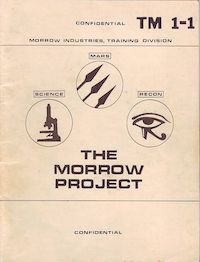 1st edition embrace | |
| Designers |
|
|---|---|
| Publishers | TimeLine Ltd |
| Publication |
|
| Genres | Post-apocalyptic |
| Systems | TimeLine System |
The Morrow Projection is a science fiction role-playing game created past Kevin Dockery, Robert Sadler and Richard Tucholka and published by TimeLine Express. Information technology is set up subsequently a devastating nuclear war. It was first released in the 1980s, and it still has a loyal following. The fourth edition was released as of December 15, 2013 past Chris Garland, the head of Timeline Limited.[1] [2]
History [edit]
In 1974, Robert Sadler wrote an outline for a post-apocalyptic take a chance story. Richard Tucholka added a 2d chapter, but then the project was buried for a year or more than. In 1975, they were introduced to role playing, and Tucholka suddenly realized that the Morrow Project could be an adventure background for a roleplaying game. He used Sadler's story as a guide to write that game background. So the two joined forces with Kevin Dockery to flesh out the military portion of the game.
After months of playtesting, it was run at an early on Michicon and was a bang-up success there. At that bespeak, Timeline Games was born and shortly thereafter, due to internal conflicts, both Richard Tucholka and Robert Sadler left Timeline Games and created Tacky-Tac Games that afterward became Tri Tac Games.
In tardily 2012 afterward several years of development a Kickstarter campaign was run to provide the funds to terminate the 4th edition of Morrow Projection.[three] The Kickstarter entrada easily exceeded its goal and finished successfully on January iii, 2013. The new edition was released on December fifteen, 2013.
Setting [edit]
The game is based effectually the idea that a group of American industrialists predicted the coming of an apocalyptic nuclear war, and began to create a plan for an emergency operations and reconstruction infrastructure that would survive that war. This plan is the eponymous "Morrow Project". A number of volunteers were cryonically frozen in hidden bunkers called boltholes. They were provided with substantial caches of supplies and equipment, intended to help the teams rebuild civilisation -- once the war had ended, information technology was idea some places would exist identified where the hazards such equally nuclear fallout had diminished sufficiently.
The programme was for the Morrow Project to be coordinated past a central command mail service and tape-keeping facility chosen "Prime Base." This is an immense self-contained bunker with various annexes, hidden underground in Nevada, in the canyons near Soldier Meadow. Its details are explained in the game book entitled "Prime Base." The facility's advanced life support systems and huge multifariousness of other equipment were intended to allow the Project's leaders not to sleep through the war, and so as to chronicle it and be in the best position to determine out what should be washed side by side. The Project's "Phoenix Team," a highly cloak-and-dagger Tier-I special operations unit of measurement of approximately platoon strength, was also here, but kept in suspended blitheness to be used only on the highest authorisation if there was no alternative.
Prime Base was built in isolation according to schedule, but just earlier it could presume its function it was sabotaged and bombed by a shadowy madman called Krell, sustaining serious damage. The sudden attack wiped out the Morrow Project leaders, just 150 years after the war, the damaged fundamental computer at Prime Base finally began to issue one or more wakeup signals. This revived at least i of the Morrow Projection assets -- the team that the role player characters are part of. The status of other Teams is purposefully kept unclear, so that details tin can be worked out by the person coordinating the game, who is called the Project Managing director.
The game therefore centers around the question of whether the Project is hopelessly compromised, or whether its scattered outposts tin can reconnect and replace the non-functional headquarters. Must they endeavor to confront huge reconstruction tasks alone, when information technology was expected that thousands of Project members would help them? Do they have the courage to attempt?
Initial scenario [edit]
The initial scenario may be played with nothing other than the game volume, dice, paper and pencil. Expansion sets are available introducing further scenarios, weapons and equipment.
One hundred and l years afterwards the Third World War, the members of the Morrow Project wake to a strange globe. Instead of being role of an organized programme to rebuild their civilization, they find themselves isolated in a world where the War is only a afar legend, the people are ignorant of anything simply the struggle to survive and strange mutated animals haunt their footsteps.
Players of the Morrow Project must non just survive, but must carry out their original mission: to rebuild the world. To exercise this they take their equipment and training, their team and their own guts and imagination. Together with their teammates they must try to do alone a job that thousands were trained to practise.
Included in the game book there are extensive details on the Morrow Project'south teams, vehicles, weapons, other equipment, medical details, the various dangers arising from nuclear weapons effects, and too information to aid the Projection Managing director make up one's mind which people and creatures be in the postal service-holocaust world -- in item various animals afflicted in either more or less scientifically accurate means. Up until Fourth Edition, there was also detailed information on which locations in the United states of america had been struck by Soviet ICBMs, which of the enemy MIRVs had failed to detonate, and which had struck targets other than those intended.
MARS, recon, science and specialty [edit]
While each squad is equipped to survive on its ain, it proved impossible to equip all the teams for every postwar contingency. For case, some Recon Teams are almost as heavily armed equally MARS Teams, while others are not.
With teams having been put to sleep over a course of several years from the 1960s onwards, there will also be variations in the equipment they have. In some cases, teams may wake to find new equipment they are not however trained on, and will accept to teach themselves from instructional materials.
Below is a full general summary of the Project groups:
- Recon: The general purpose teams of the Project and the about numerous, Recon teams are equipped with varying types of weapons and equipment ranging from V-150 armored cars to SK-5 hovercraft. Their orders are to reconnoiter the countryside, report on local weather condition, and provide advice to Prime Base of operations apropos which teams should exist awakened next.
- MARS: These teams make upward the military arm of the Project -- they are extremely formidable and heavily armed. In improver to conventional weapons, some of these teams take man-portable laser weapons, and some take an early generation of no-nonsense, minimalist powered armor. The purpose of the MARS teams is to back up and defend civilians and other teams. A big portion of MARS team members are ex-armed forces personnel with combat feel. MARS stands for One thousandobile Assault, Rescue and Southwardtrike. Some MARS teams have heavy vehicles such equally the Mars One. The Mars One is a large custom-built articulated vehicle with very heavy armor and powerful weapons. It is able to carry troops, employ onboard sensors, provide early alert, and serve as a control mail service.
- Science: The Scientific discipline teams are broadly cross-trained scientific and technical units that can cope with a wide range of situations -- from circuitous medical care and epidemiology to understanding unusual hazards and unsafe creatures. Their areas of knowledge range from biology to nuclear physics. They are equipped with a 2nd type of versatile custom-congenital articulated vehicle, called the Science 1, and accept armament 2nd but to that of the MARS teams.
- Specialty: This is a broad term applied to Projection groups that have a non-standard function in regard to their equipment and personnel. Specialty groups generally consist of assets frozen with orders to meet at a predesignated point. Most Specialty teams are not as heavily armed as Recon or MARS teams, considering the Project's planners felt that those teams could not fully perform the necessary functions if survivors felt threatened by them. Specialty groups assigned to the Projection include:
- Technology: Edifice, structure, repair and maintenance of Project and noncombatant equipment.
- Agricultural: Farming and livestock preserved past using frozen embryos. Equipped to build and assist farming communities.
- Psychological: Formed to handle extremist groups, riots, negotiation challenges, and other serious problems acquired by stress.
- Aviation: Air survey reconnaissance, fire support, and air mobility support for other teams. These missions are done with fixed-wing aircraft including cargo planes, as well as calorie-free helicopters, early types of unmanned aerial vehicles, and custom-congenital autogyros that are modular and human-portable.
- Command: Oversight of Combined Grouping avails, both mobile field teams and fixed installations, generally for a city or limited geographical area such as. Combined Grouping Seattle.
- Frozen Watch: Casualty replacement personnel for the field teams, as well every bit Morrow Project field police, internal security, and counterintelligence functions.
- Ability Reception: Reception of electrical power which is scheduled to be transmitted via microwaves, one time Morrow Project ability satellites have been lofted.
- Back up: Logistical support such equally supply, repair, and replacement operations.
- Communications: Restore radio frequency, laser microwave, and eventually fifty-fifty satellite communications. They also maintain the project's clandestine extremely low frequency systems that very slowly accrue Prime Base of operations's messages, such equally briefings, for teams to read when they awaken—thus counterbalancing the minuscule data rate. For security reasons, ELF systems were not for use until after the war.
- Medical: Health care for the general population and for project avails. Generally equipped with a fixed installation.
- Decontamination: Render safe personnel, vehicles and structures contaminated by radiological, biological, or chemic hazards. As well assist in the salvage of equipment and materials recovered from unsafe areas.
Publications [edit]
Supplements [edit]
- Game Primary'due south Package: Basic Vehicular Loads was a supplement detailing basic equipment loads, with 3 copies of each, for xi dissimilar Morrow Project vehicles.[4] It was published past Timeline Ltd. in 1980 equally 39 xeroxed sheets, stapled in groups.[4] A 2nd edition was published in 1980, equally 39 loose-foliage hole-punched sheets with a large envelope.[iv] William A. Barton reviewed Vehicular Basic Loads in The Space Gamer No. 48.[5] Barton commented that "If y'all're a Morrow Project GM, you lot should find these Vehicular Base Loads sheets of employ in your campaigns."[5]
- The Morrow Project Vehicular Blueprints (1980)
- Personal Basic Loads (1980)
- The Morrow Project Gamemaster'south Shield and Reference Tables (1981)
- Security Comprehend Sheets (1981)
- Personal and Vehicular Bones Loads and The Morrow Projection Role Playing Expansion (1983)
- Project Director'south Shield
Adventures [edit]
- Damocles (1982)
- Liberation at Riverton (1982)
- Operation Friction match (1982)
- The Ruins of Chicago (1983)
- The Starnaman Incident (1984)
- Operation Lonestar (1985)
- Desert Search (1986)
- Prime number Base (1987)
Reception [edit]
In the May 1981 edition of The Space Gamer (Consequence No. 39), William A. Barton commented that "overall, I'd have to give The Morrow Project the highest of ratings every bit a SF part-playing organisation. If it isn't at least nominated for the Origins awards this year, there merely ain't no justice in gameland.".[v]
In the June 1981 edition of Dragon (Outcome #l), Beak Fawcett thought the gainsay realism of the rules made it "suitable, with very few changes, for a role-playing game of Earth War Iii infantry and armored combat." He did note the resultant complexity of the rules, saying, "The toll of this realism is the great amount of die-rolling necessary to determine the location and consequence of wounds." Fawcett was non as impressed with the rest of the rules. "There is nothing too distinctive about the game system as a whole." He suggested that two types of gamers would exist interested in this game: "those who are interested in modern weapons and combat, and those who play the Gamma World game, who volition find the ideas in this game readily adaptable to that organization."[6]
Chris Baylis reviewed The Morrow Project for Imagine magazine, and stated that "My first impressions of the Morrow Project made me want to brainstorm a game immediately. The thought seemed new and exciting, and the system looked avant-garde, well thought out and imaginative."[7]
Phil Masters reviewed The Morrow Project for White Dwarf #42, giving information technology an overall rating of 5 out of 10, and stated that "The Morrow Project is a game with a very specific fashion, a lot of strengths. and a lot of weaknesses. Like whatsoever mail-holocaust game, information technology may be a piddling depressing; it is certainly quite violent. It is, past current standards, simple and playable, and could be worse at the price."[8]
Reviews [edit]
- Dissimilar Worlds #33 (March/Apr, 1984)
- Casus Belli #30 (Jan 1986)[ix]
References [edit]
- ^ "Wee Gamers Podcast ... An interview with Chris Garland (pt2)". Wee Gamers. Archived from the original on 2016-05-21.
- ^ "Timeline Homepage". Timeline LTD.
- ^ "The Morrow Project 4th. Edition by Chris Garland — Kickstarter". Kickstarter.
- ^ a b c Schick, Lawrence (1991). Heroic Worlds: A History and Guide to Function-Playing Games. Prometheus Books. p. 254. ISBN0-87975-653-5.
- ^ a b c Barton, William A. (May 1981). "Featured Review: The Morrow Project". The Space Gamer. Steve Jackson Games (39): 22–23.
- ^ Nalle, David (June 1981). "The 'Zines". Dragon. TSR, Inc. (50): 24–25.
- ^ Baylis, Chris (May 1983). "Game Reviews". Imagine (review). TSR Hobbies (UK), Ltd. (ii): 38.
- ^ Masters, Phil (June 1983). "Open Box: The Morrow Project – Liberation at Riverton". White Dwarf (review). Games Workshop (42): 17. ISSN 0265-8712.
- ^ "The Morrow Projection | Article | RPGGeek".
External links [edit]
- Timeline Ltd home page [ expressionless link ]
- Morrow Project Travel and Chance Guide
- Entry in RPG.internet Game Index
- Morrow Project 4th Edition on Project Kickstarter
- Wee gamers podcast interview with Chris
DOWNLOAD HERE
Posted by: kathrynstindere.blogspot.com


0 Comments